

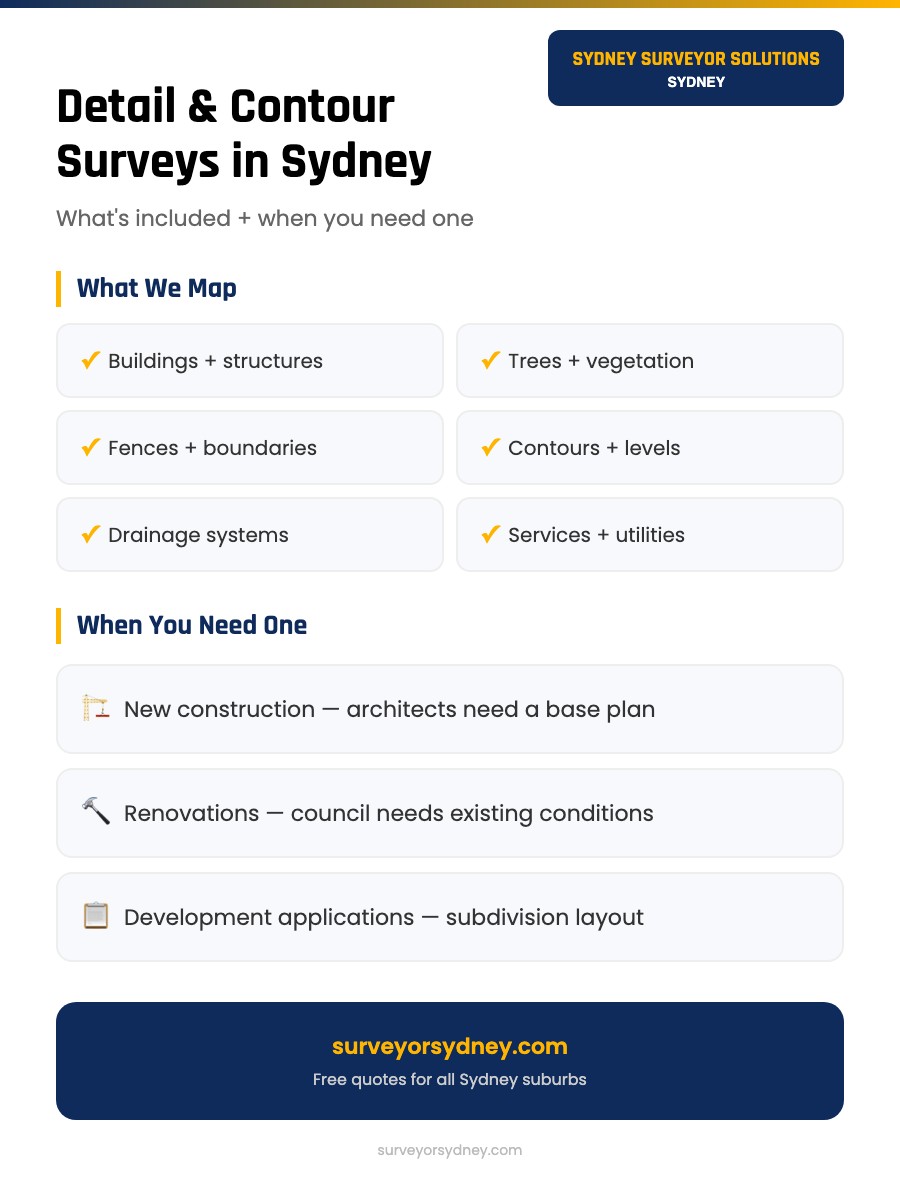
A detail survey (also called a topographic survey or feature survey) maps the physical reality of your site—ground levels, contours, buildings, fences, retaining walls, trees, driveways, kerbs, pits, visible services, and other features. It produces a scaled plan that architects, designers, engineers, and planners rely on for accurate design and documentation.
In Sydney, a good detail survey often makes the difference between a smooth DA/CDC process and multiple rounds of redesign. If your drawings don’t match what is actually on site (levels, drainage paths, easements, or structures), councils and certifiers will usually request more information.
How Much Does a Detail Survey Cost in Sydney?
A detail survey in Sydney typically costs $1,500 to $4,000 (inc GST) for a standard residential property. Pricing depends on the time on site and the drafting complexity. Costs can increase for:
- Larger blocks (more area to capture)
- Heavily vegetated sites (harder access and visibility)
- Steep terrain (more levels/spot heights needed)
- Complex improvements (retaining walls, pools, multiple structures)
- High-detail deliverables (e.g., additional sections, extra spot levels)
As a rough guide, a basic detail survey for a ~600sqm suburban block may start around $1,500, while a steep or highly constrained site can push closer to $3,000-$4,000.
What Information Is Included in a Good Detail Survey?
While scope varies, architects generally expect a detail survey to include:
- Contours (e.g., 0.5m or 1.0m intervals depending on slope)
- Spot levels at key points: corners, ridges, swales, around buildings
- All visible structures: house, garages, sheds, decks, stairs
- Fences and retaining walls (with notes on material/height where relevant)
- Driveways and hardstand including crossings and kerb alignments
- Services features observed on site: pits, grates, meters, poles
- Street information: kerb, gutter, footpath, street levels
- Neighbouring context where helpful: adjacent building outlines/levels as visible
Many DA designs fail at the first pass because drawings assume flat sites or ignore existing stormwater paths. A detail survey provides evidence-based levels and features for drainage and retaining design.
When Do You Need a Detail Survey?
You typically need a detail survey when:
- Designing a new dwelling, duplex, or major extension
- Preparing documents for a DA with your local council
- Applying for a CDC through a private certifier (compliance still needs accurate site data)
- Planning earthworks, drainage upgrades, retaining walls, or landscaping
- Resolving flooding/overland flow issues
- Preparing a site for subdivision or strata (often alongside boundary work)
Under the Environmental Planning and Assessment Act 1979, councils assess impacts such as drainage, overlooking, and excavation. A detail survey helps your designer respond accurately to these considerations across different Sydney council areas.
Detail Survey vs Boundary Survey (Do You Need Both?)
A boundary survey defines your legal boundaries. A detail survey maps features within (and near) those boundaries. Some detail surveys include a “boundary position for planning” based on available evidence (see our guide on how to read a survey plan in NSW), but if you are building close to the boundary (common in Inner West and City of Sydney areas), a full boundary re-establishment may be essential.
Many projects require both: boundaries for legal certainty and setbacks, and detail for design and levels.
DA vs CDC: Why Accuracy Matters in Both Pathways
Even when a project is eligible for CDC, certifiers still need to verify setbacks, site coverage, and compliance with planning controls. The difference is that CDC aims to confirm compliance against preset standards, while DA involves broader merit assessment by council.
In both pathways, inaccurate site levels or a misunderstood boundary position can lead to:
- Design changes late in the process
- Requests for information from council/certifier
- Construction delays and extra consultant fees
How Long Does a Detail Survey Take?
A detail survey typically takes 1–2 days on site for a standard block, with the completed plan delivered within 5–10 business days. Complex sites (dense vegetation, multiple structures, difficult access) may take longer. Rush services can be available when you’re trying to meet a lodgement deadline.
How to Prepare Your Property for the Survey (Quick Wins)
- Unlock side gates and ensure access to rear areas
- Move cars off the driveway if possible (so levels can be captured)
- Trim heavy vegetation that blocks visibility to retaining walls/fence lines
- Let the surveyor know about any hazards (dogs, unstable ground, construction works)
FAQ
Do I need a detail survey for a small renovation?
If your renovation affects drainage, involves excavation, or needs DA/CDC drawings, a detail survey is usually worthwhile. For internal-only works, you may not need one.
Will a detail survey show easements?
The survey plan can reference easements if provided from title/DP information, but confirming the legal terms often requires reviewing the relevant instruments (including Section 88B instruments under the Conveyancing Act 1919) and plan history.
Can a detail survey include boundaries?
It can, but if you are building close to the boundary or there’s uncertainty (missing marks, older plans), ask for boundary re-establishment so your designer has defensible setbacks.
What file formats do architects prefer?
Many architects prefer PDF plus CAD formats (DWG/DXF). Confirm with your designer before booking so the deliverables match your workflow.
How do I book a detail survey in Sydney?
Contact Sydney Surveyor Solutions via surveyorsydney.com or call (02) 5114 2551. Sharing your address, site access notes, and a copy of any existing plans helps speed things up.

