

Yes, you typically need a survey to build a granny flat in Sydney. At minimum, most designs require accurate site information for the approval pathway (DA or CDC), and then a setout during construction to ensure the building is positioned correctly.
Survey costs vary by site, but common Sydney benchmarks include:
- Detail/contour survey: $1,500-$4,000 for many residential sites (simpler sites may be lower depending on scope)
- Boundary identification / identification survey: $600-$1,200 if boundary position needs confirmation
- Construction setout: $400-$800 for many granny flat setouts
Total survey-related costs for a granny flat project are often in the range of $1,900 to $5,000 depending on site complexity and what’s already available.
What Type of Survey Do You Need for a Granny Flat?
For a granny flat in Sydney, you typically need:
- Detail Survey: shows existing structures, fences, levels/contours, driveways, retaining walls, and visible services—used by designers and certifiers/councils
- Boundary Survey (when needed): if you’re building close to boundaries or there’s uncertainty due to missing marks or old fences
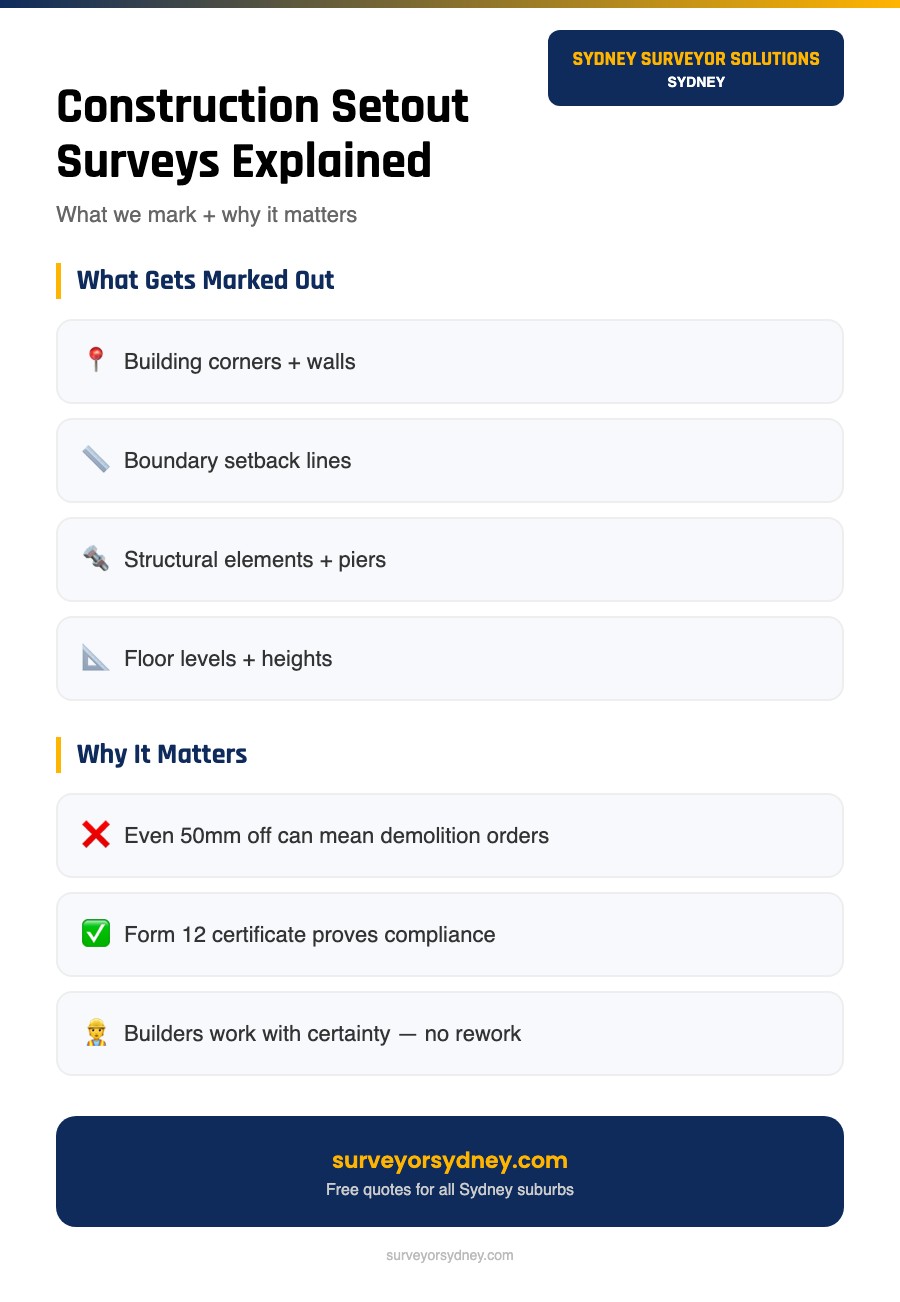
- Setout Survey: marks exact building corners/lines before slab or footings
DA vs CDC for Granny Flats (Why the Survey Still Matters)
Many granny flats are pursued under CDC where eligible, but that does not remove the need for accurate site information. Certifiers must verify compliance with key controls such as setbacks, site coverage, and sometimes landscaping/drainage constraints.
In DA situations, councils assess broader impacts under the Environmental Planning and Assessment Act 1979 and local controls. In both pathways, survey data underpins:
- Accurate setbacks to boundaries
- Existing ground levels (important for drainage and retaining)
- Location of existing structures and trees that may affect design
Why Boundary Certainty Matters for Granny Flats in Sydney
Granny flats are often placed toward the rear of the lot, where:
- Fences may not match the true boundary
- Rear drainage easements are common
- Neighbouring structures are close, limiting siting options
A boundary survey can be especially important if your design pushes tight side setbacks (common on 10–12m wide lots in many suburbs). Boundary definition in NSW depends on plan evidence and field marks administered through NSW Land Registry Services (LRS), interpreted under the Surveying and Spatial Information Act 2002 (NSW).
Can You Build a Granny Flat Without a Survey?
It’s not recommended and usually not practical. Without survey data, your designer is forced to guess levels and site constraints, increasing the risk of non-compliance and rework. During construction, relying on tape measures from an old fence line is a common cause of setback breaches (see fence survey guidance).
Fixing a siting error after a slab is poured can be far more expensive than getting the setout correct from day one.
Common Council/Certifier Documentation Needs
While requirements vary across councils (City of Sydney, Inner West, Bayside, Northern Beaches, Sutherland Shire, etc.), survey-informed plans typically help with:
- Site plan accuracy (existing buildings, fences, driveways)
- Drainage design and overland flow considerations
- Tree impacts and retaining wall design on sloping blocks
Common Sydney Constraints: Easements, Drainage, and Trees
Many granny flat sites have constraints that only become obvious once survey data is on the table:
- Rear drainage easements that limit where footings and slabs can go
- Stormwater flow paths that require careful finished levels and surface grading
- Retaining walls on sloping blocks (common in Northern Beaches and parts of the North Shore)
- Significant trees that influence siting, excavation, and approval conditions
A good detail/contour survey captures the levels and visible features your designer needs to plan drainage and avoid costly redesign.
Typical Survey Timeline for a Granny Flat Project
- Detail survey completed so the designer can draft accurate plans
- DA or CDC documentation prepared using survey levels and existing feature locations
- Boundary confirmation if setbacks are tight or the fence line is uncertain
- Construction setout once excavation is complete and before formwork/slab
What to Send Your Surveyor Before Booking
- Any existing plans or sketches you have (even old ones)
- A rough idea of the proposed granny flat position (rear/side)
- Notes on access (locked gates, dogs, tenants)
- Whether you are pursuing DA or CDC (and your intended timeframe)
FAQ
What is the most important survey for a granny flat?
Usually the detail/contour survey (for design and approvals) and the construction setout (for building positioning). Boundary work is essential if you’re close to boundaries or unsure of the line.
How much does a setout for a granny flat cost?
Commonly $400-$800 depending on access, points required, and whether additional height control is needed.
Do I need a boundary survey if I already have a fence?
Not always, but fences are frequently off the legal boundary. If you’re pushing tight setbacks or there’s any neighbour concern, boundary confirmation is strongly recommended.
How long does it take to get the survey done?
Many surveys can be delivered within 5–10 business days depending on complexity and workload. If you have a lodgement deadline, ask about priority options.
Who should I contact in Sydney?
Sydney Surveyor Solutions can assist with detail surveys, boundary definition, and setout. Call (02) 5114 2551 or visit surveyorsydney.com.

