

An identification survey identifies the position of your property boundaries relative to existing fences, structures, and improvements. It helps answer practical questions like: “Is the fence on the boundary?” and “Is the garage encroaching?”
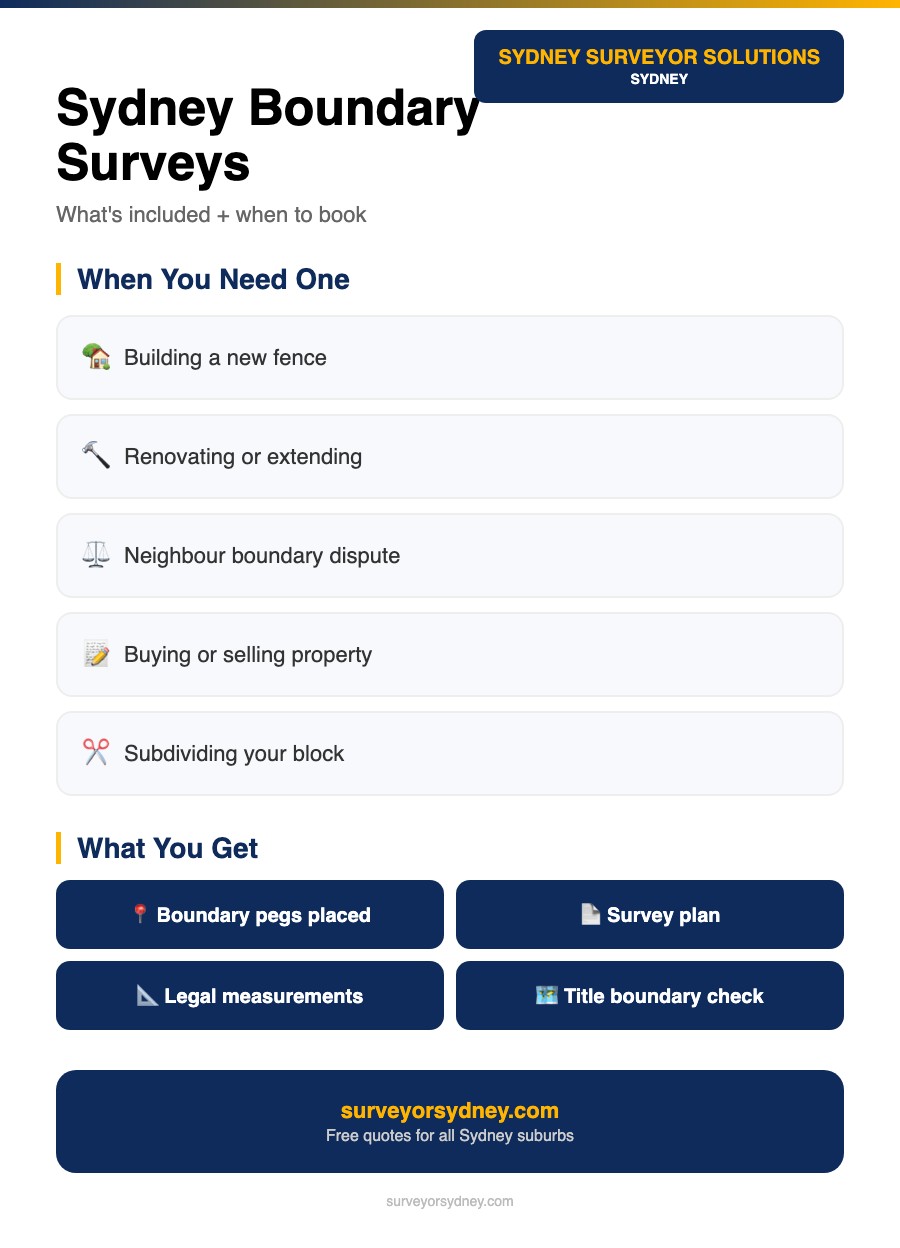
In Sydney, identification surveys are commonly requested before replacing fences (see survey before building a fence), buying property, building near boundaries, or when a neighbour dispute is brewing.
How Much Does an Identification Survey Cost?
An identification survey in Sydney typically costs $600-$1,200 (inc GST). Straightforward properties with good mark availability and clear evidence tend to be cheaper. Costs rise when survey marks are missing, access is difficult, or the boundary history is complex.
If you need new permanent marks re-established and placed, a full boundary survey may be more appropriate, commonly $800-$1,800+ for simpler scopes and up to $1,800-$3,500 for full re-establishment where required.
Identification Survey vs Boundary Survey
An identification survey focuses on showing where boundaries sit relative to existing features (fences, walls, sheds) and may not involve reinstating permanent survey marks. A boundary survey (particularly re-establishment) aims to define the legal boundary with higher certainty and often includes placing marks.
Identification surveys are often cheaper but provide less “ground marking”. If you need pegs/marks for construction, confirm the scope before booking.
When Do You Need an Identification Survey?
You may need an identification survey when:
- Buying a property and you want to verify fence positions
- Planning to build close to boundaries (decks, extensions, retaining walls)
- Settling a potential boundary dispute
- Checking whether improvements encroach
- Before building a new dividing fence under the Dividing Fences Act process
What the Surveyor Will Do (Behind the Scenes)
Even for an “identification” scope, there is still significant work involved:
- Researching DP history and title references through NSW Land Registry Services (LRS)
- Searching for survey marks (iron pipes, concrete posts, drill holes)
- Measuring fences and improvements relative to the boundary position
- Preparing a plan/sketch showing offsets and any apparent encroachments
Boundary interpretation in NSW is governed by established survey practice and the Surveying and Spatial Information Act 2002 (NSW). This is why “measuring off Google Maps” is not a substitute for a survey.
Will an Identification Survey Place Boundary Marks?
Not always. Identification surveys are primarily about reporting the relationship between boundaries and existing features. If existing survey marks are found, they can be referenced. If you need marks placed for construction or future certainty, ask for mark placement or a re-establishment survey.
How Identification Surveys Help Avoid Costly Mistakes
Typical problems avoided include:
- Replacing a fence “in the same spot” when the existing fence is already off line
- Building a shed/deck that crosses a boundary by a small but significant amount
- Starting a DA/CDC design based on incorrect boundary assumptions
Small offsets matter in Sydney. A 150mm encroachment can become a major dispute on narrow lots.
What Does the Final Plan Usually Show?
An identification survey plan commonly shows (and many owners also request a property report when buying):
- The boundary line position (based on evidence found)
- Existing fence lines and key structures near the boundary
- Offsets from the boundary to those structures (often in millimetres)
- Notes about marks found (or not found) and any limitations
If the Survey Shows an Encroachment, What Next?
If an improvement appears to encroach, the next steps depend on seriousness and neighbour relationships. Options may include:
- Talking early with the neighbour and sharing the survey findings
- Obtaining legal advice about rights and remedies
- Adjusting design decisions (e.g., fence replacement position) to avoid escalation
In many Sydney cases, early clarification prevents disputes from escalating into expensive legal processes.
Pre-Purchase Tip: Don’t Assume “Existing Use” Matches Title
If you’re buying and planning to renovate, an identification survey can be a relatively low-cost way to confirm that fences and improvements align with title. It’s particularly useful where rear lanes, irregular lots, or older subdivisions exist.
How This Fits With DA/CDC Building Projects
If you’re lodging a DA or CDC and building near a side setback, an identification survey can highlight risks early. If the boundary evidence is weak or stakes are high, upgrading to a boundary re-establishment survey can provide stronger certainty for design and construction setout.
FAQ
Is an identification survey enough for building a new fence?
Often yes if you just need confidence about the line and the corners can be identified. If corners can’t be confirmed or you want permanent marks, a boundary re-establishment may be better.
Does an identification survey prove an encroachment legally?
It provides professional measurement evidence of where improvements sit relative to the boundary position. If a dispute escalates, further steps and advice may be required.
Can an easement affect where my fence goes?
Sometimes. Easements often relate to services and access, and while they don’t always prevent fences, they can affect what can be built and where access must be maintained. The Section 88B wording is important.
How long does an identification survey take?
Many are completed within 5–10 business days, depending on research complexity and workload.
Who can help in Sydney?
Sydney Surveyor Solutions can assist with identification and boundary surveys across Sydney. Call (02) 5114 2551.

