

Subdivision in Sydney typically takes 6–12 months (see our Subdivision Surveys service) from start to finish, and sometimes longer. A straightforward 2-lot subdivision with no major servicing constraints may complete in 6–8 months, while more complex projects can run 12–18 months or beyond.
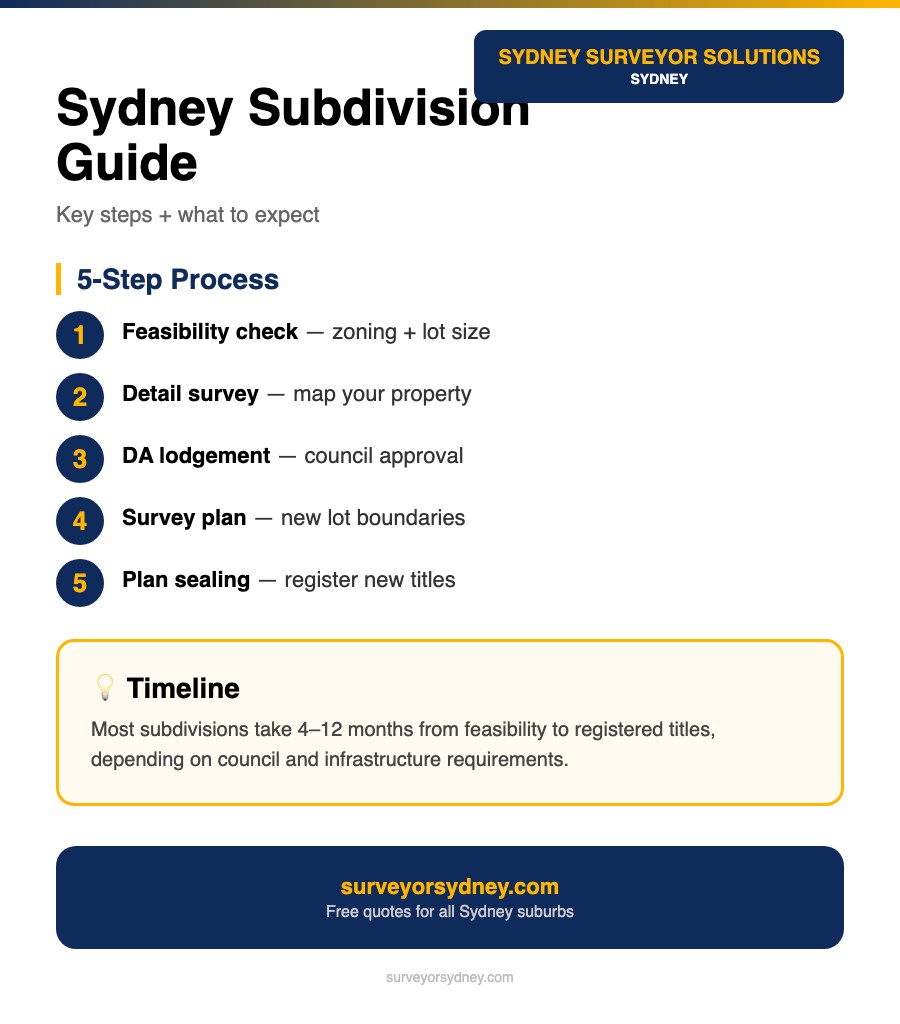
The timeline is driven by three things: the approval pathway (DA vs CDC), the conditions (servicing and contributions), and how quickly documentation can be produced and corrected.
Stage 1: Feasibility and Early Research (2–6 Weeks) (including early boundary survey review)
Before lodgement, it’s worth investing time in:
- Reviewing minimum lot sizes and subdivision controls for your council area
- Checking title constraints (easements, restrictions on use, covenants)
- Confirming servicing and stormwater feasibility
- Engaging a professional surveyor for initial boundary review
Title and plan research usually involves accessing DP/SP records (see how to read a survey plan in NSW) via NSW Land Registry Services (LRS). If easements or restrictions need to be created, that may involve drafting a Section 88B instrument under the Conveyancing Act 1919.
Stage 2: DA Assessment Time (Commonly 3–6 Months)
Council DA assessment for subdivision often takes 3–6 months in Sydney. Some simple applications may be approved faster, while others take longer due to requests for information, neighbour submissions, or servicing issues.
Factors that affect DA timing include:
- Council workload and resourcing
- Completeness and clarity of the application
- Whether additional reports are required (traffic, stormwater, arborist, etc.)
- Complexity of the site (heritage, flooding, steep land)
All of this occurs within the planning framework of the Environmental Planning and Assessment Act 1979.
Stage 3: CDC Pathway (Sometimes Faster, But Strict)
The fastest pathway can be CDC in limited scenarios, with approvals sometimes achieved in roughly 20 days when eligibility is clear.
CDC subdivisions have strict criteria. If the proposal needs variations, new easements, or complex servicing solutions, DA is more likely.
Stage 4: Conditions, Servicing, and Compliance Works (1–6+ Months)
After approval, time is often consumed by meeting conditions such as:
- Stormwater design and implementation
- Driveway/access upgrades
- Utility connections and authority requirements
- Payment of contributions and fees
This stage varies significantly by council area and site constraints (for example, constrained drainage in older Inner West suburbs vs steep blocks in Northern Beaches).
Stage 5: Survey Work and Plan Finalisation (4–8 Weeks)
Survey work for subdivision is not a single event. It often includes boundary definition, drafting, revisions, and final plan preparation. A realistic allowance is 4–8 weeks across the project for:
- Initial boundary identification and draft plan preparation (2–4 weeks)
- Revisions required by council/certifier and consultants (1–2 weeks)
- Final survey and subdivision plan completion after conditions are met (1–2 weeks)
Actual time on your property might only be 1–2 days, but drafting and coordination take time.
Stage 6: Subdivision Certificate and Registration (4–8 Weeks Total)
Once conditions are met, you generally obtain a subdivision certificate (or equivalent certification step) and then lodge for registration. Registration with NSW LRS commonly takes 2–4 weeks after lodgement, subject to examination queues and requisitions.
Fastest Ways to Keep Your Subdivision Moving
- Start with accurate survey and title research (avoid redesign late)
- Respond quickly to council/certifier requests
- Address stormwater early (a major timeline driver in Sydney)
- Minimise plan changes once lodged to reduce loops
Example Timeline: Straightforward 2-Lot Subdivision
While every site differs, a common pattern looks like:
- Weeks 1–4: feasibility, survey/title research, concept design
- Months 2–4: DA lodgement and assessment (allow longer in busy council periods)
- Months 4–7: satisfy conditions (stormwater/access/services), finalise subdivision documentation
- Months 7–9: certification, lodgement, NSW LRS examination and registration
Where the Surveyor Fits in the Timeline
A professional surveyor is typically involved at multiple points:
- Early: boundary definition and plan research for feasibility
- Mid: draft subdivision plan, coordination on easements/restrictions (Section 88B)
- Late: final survey and plan finalisation for lodgement with NSW LRS
Common Bottlenecks Across Sydney Councils
Different council areas have different pressure points. Some common patterns include:
- Inner West / City of Sydney: heritage overlays, stormwater constraints on older drainage infrastructure, and tight lots that require careful easement drafting
- Northern Beaches: steep terrain, bushfire considerations, and longer DA assessment periods
- Sutherland Shire / Bayside: flooding overlays, on-site detention requirements, and contributions that can add weeks of coordination
Understanding your council's typical pain points helps set realistic expectations from the start. If you want an estimate for your site, contact our team.
FAQ
How long does a simple 2-lot subdivision take in Sydney?
Often 6–8 months if the DA is straightforward and servicing is simple, but 6–12 months is a safer general expectation.
Can a CDC subdivision really be done in 20 days?
CDC assessment can be fast when eligibility is clear, but many subdivisions don’t qualify due to constraints, easements, or variations to controls.
What usually causes the biggest delays?
Stormwater design/approval, authority requirements, incomplete documentation, and responding to council requests are common delay points.
How long does NSW LRS registration take?
Commonly 2–4 weeks after lodgement, but it can vary based on examination queues and whether requisitions are issued.
Do I need a Section 88B instrument for my subdivision?
Only if you need to create easements, restrictions on use, or covenants as part of the subdivision. Many Sydney projects do require this due to drainage and access constraints.

